default.html.twig template not found for page: /resources/dui-dwi/minnesota-dwi-license-revocation-first-offense-vs-second-test-failure-vs-refusalThree variables determine Minnesota's license revocation length: (1) how many qualified prior impaired driving incidents (QPIDIs) you have had within the past 20 years, (2) your BAC at the time of testing or whether you refused, and (3) whether the offense involved injury or death. These factors interact to produce outcomes ranging from 30 days to a lifetime cancellation.
Under Minn. Stat. § 171.178 (2025), the Minnesota Department of Public Safety administers license revocation, cancellation, and reinstatement. The statute distinguishes between:
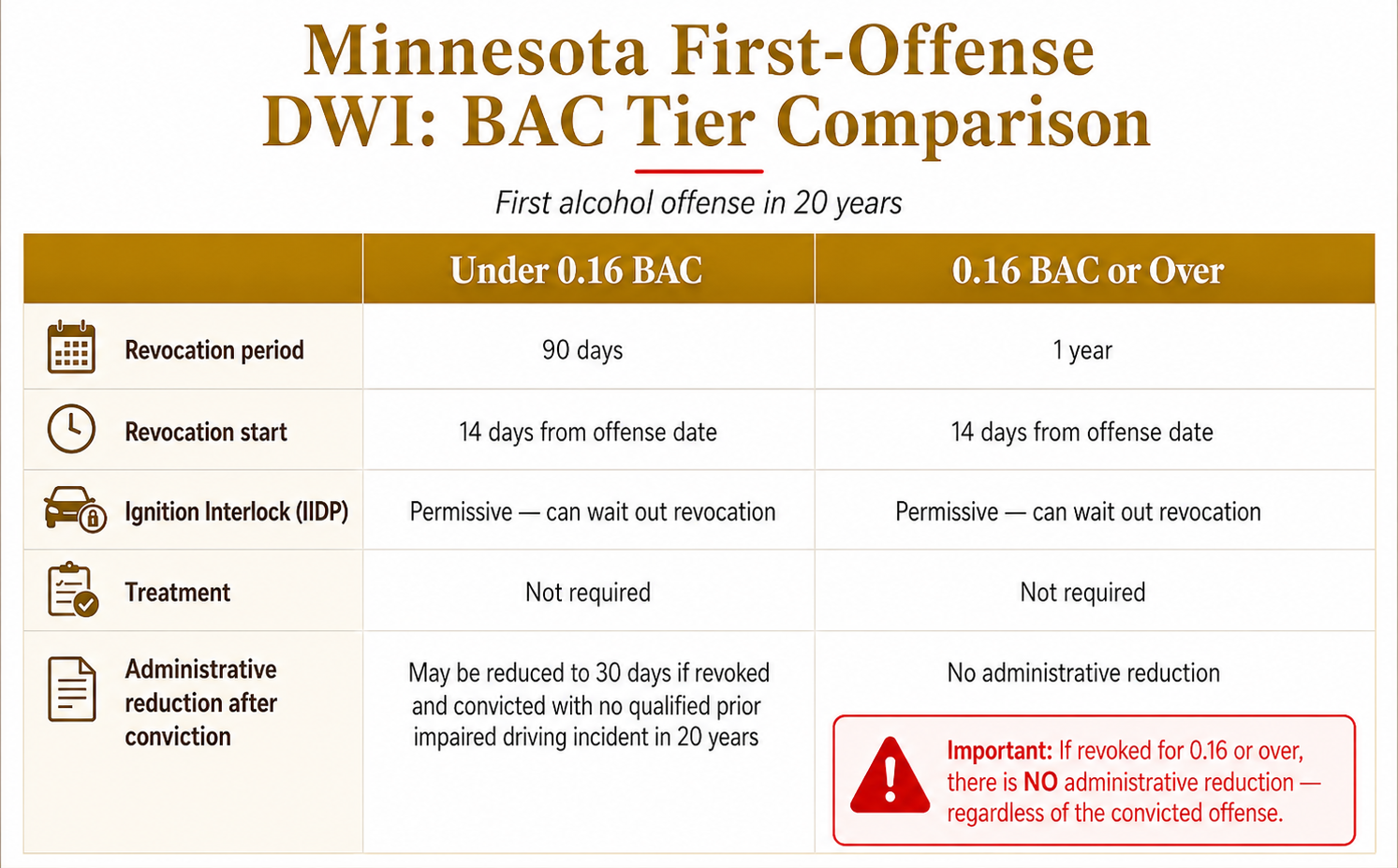
On a first DWI offense with no QPIDIs in the past 20 years, a BAC under 0.16 results in a 90-day revocation. A BAC of 0.16 or above doubles that to 1 year. In both cases, the Ignition Interlock Device Program is optional, treatment is not required, and a limited license is available after 15 days.
If the driver is convicted and has no QPIDIs within the past 20 years, the revocation period may be administratively reduced to 30 days (or 120 days if the offense involved injury or death). See Minn. Stat. § 171.178, subd. 5(a)(1)(i).
The 0.16 threshold represents twice the legal limit of 0.08 and triggers an automatic doubling of the revocation period. This applies regardless of whether the ultimate criminal conviction is for a lower-level offense.
Refusing a chemical test on a first offense results in a 1-year revocation, the same as a high-BAC failure. Revocation begins 7 days after the offense (earlier than test failure cases). The IIDP is optional, and treatment is not required. An administrative reduction to 90 days is available upon conviction with no prior QPIDIs.
Refusal is treated as seriously as a high-BAC failure under Minnesota law. The earlier revocation start date (7 days vs. 14 days for test failure) means a driver loses their license sooner. Attorneys sometimes advise clients to consider this tradeoff, but the decision involves a case-specific strategy.
Any second alcohol offense within 20 years -- regardless of BAC level or test refusal -- results in a mandatory 2-year IIDP period before full driving privileges are restored. There is no option to wait out the revocation. Treatment is also mandatory.
Under Minn. Stat. § 171.178, subd. 4(2) and 3(2), a person with one QPIDI within the past 20 years faces the same outcome whether their BAC was 0.08 or 0.20, or whether they refused testing:
The 2-year IIDP clock does not begin until the driver enrolls. Delaying enrollment extends the total time before full reinstatement.
Drivers with two or more QPIDIs who are convicted of a new DWI offense face license cancellation and denial as "inimical to public safety" under Minn. Stat. § 171.178, subd. 7. A third offense requires 6 years on the IIDP; a fourth or subsequent offense requires 10 years. These periods begin only upon IIDP enrollment.
| Offense Count | Time on IIDP | Cancellation Start |
|---|---|---|
| Third offense on record | 6 years | Upon IIDP admission |
| Fourth or subsequent | 10 years | Upon IIDP admission |
Both require mandatory IIDP participation and completion of a licensed substance use disorder treatment program before full driving privileges may be restored.
Violations while enrolled in the IIDP extend the required participation period:
All extensions are consecutive, not concurrent.
If a participant commits an act involving alcohol that results in a new license revocation, they are terminated from the IIDP and must reapply and restart. Credit rules vary:
The most significant structural difference between a first and second offense is not the revocation length per se, but whether the IIDP is mandatory and whether treatment is required. First offenses allow the driver to simply wait out the revocation. Second offenses do not.
| Factor | First Offense | Second Offense |
|---|---|---|
| BAC under 0.16 | 90-day revocation | 2-year mandatory IIDP |
| BAC 0.16 or above | 1-year revocation | 2-year mandatory IIDP |
| Test refusal | 1-year revocation | 2-year mandatory IIDP |
| IIDP | Optional | Mandatory |
| Treatment | Not required | Required |
| Limited license | After 15 days | Not applicable |
| Administrative reduction | Available (in some cases) | Not available |
Convictions for criminal vehicular operation (CVO) or criminal vehicular homicide (CVH) under Minn. Stat. § 609.2112-2114 trigger separate cancellation periods under § 171.178, subd. 6 and 8. These periods range from 2 years (first CVO, bodily harm) to lifetime cancellation (third or subsequent CVH).
| Offense | Bodily Harm / Substantial Bodily Harm | Great Bodily Harm |
|---|---|---|
| 1st offense | 2 years | 6 years |
| 2nd offense (lifetime) | 5 years | 8 years |
| 3rd offense (lifetime) | 8 years | 10 years |
| 4th offense (lifetime) | 10 years | 10 years |
| Offense | Cancellation Period |
|---|---|
| 1st offense | 6 years |
| 2nd offense (lifetime) | 15 years |
| 3rd offense (lifetime) | Lifetime |
| 4th offense (lifetime) | Lifetime |
All CVO and CVH cancellations require mandatory IIDP participation and treatment. Cancellation begins upon IIDP admission.
On a first offense, a limited license ("work permit") is available after 15 days of revocation. This applies to test failure and test refusal cases where the driver has no QPIDIs in the past 20 years.
Yes, in some cases. For first offenses under 0.16, the revocation may be administratively reduced upon conviction. However, for offenses involving a BAC of 0.16 or above, no administrative reduction is available regardless of the convicted offense.
A QPIDI includes prior DWI convictions, license revocations for DWI-related conduct, and certain equivalent out-of-state incidents. The full definition is in Minn. Stat. § 169A.03, subd. 22. Counting rules are governed by § 169A.09.
For first offenses, treatment is not required and does not affect the revocation timeline. For second and subsequent offenses, completing a licensed substance use disorder treatment program is a mandatory precondition for reinstatement -- it does not shorten the IIDP period but must be completed before full privileges are restored.